Getting your daily exercise quota in can sometimes be difficult – life just gets in the way! Maybe it’s work, or family commitments, commuting or availability of nearby facilities because you are on the road. Regardless, some days it can feel like there is a conspiracy to stop you maintaining your healthy lifestyle! If time is short, it’s all too easy to cut exercise completely from your daily schedule but if you have just a few minutes free, it’s possible to get an effective workout “on the go” which won’t take up too much time but will still be beneficial.
Many exercisers fail to see the benefit of shorter workouts but I believe this has a lot to do with the fact that historically, most people’s workouts usually come in at a fixed duration such as 45 minutes or 60 minutes. In addition to the time spent exercising, we also have to get to and from the gym, get changed into workout clothes, pass pleasantries with fellow exercisers, shower after exercise, change back our regular clothes and then get ourselves home. That 60 minute workout could end up using 2 or more hours of valuable time! It’s no wonder that sometimes it’s just not possible to fit in a workout if time becomes short.
Luckily, there is a solution – the periodic inclusion of mini-workouts that can be performed anywhere from the home to the office which use a minimum of gym equipment and take a maximum of 30 minutes from start to finish. Now I’m not suggesting you forgo your regular gym visits in favour of these mini-workouts but when it comes to beating the time crunch any exercise is better than none. You can view these workouts as “break out in case of time emergency” sessions to use when you can’t stick to your normal routine.
Make sure you spend a few minutes warming and before and cooling down after any exercise session.
1) The out and back
This cardio workout will get your heart racing, your blood pumping and burn plenty of calories whilst requiring nothing more than a stopwatch and your regular exercise clothing. Simply head out the door (either walking, jogging, running or cycling) at a steady and comfortable pace (preferably on a flat road/pavement) and continue for 10 minutes and then try to make it back to the start faster than you went out. This first 10 minutes should be graduated (i.e. start easy and build up progressively) and constitutes your warm up. After the turnaround and as you get closer to home, really begin to push the pace so that you race to see how quickly you can complete the return journey. On completion, spend a couple of minutes walking slowly before performing a few stretches for the lower body and you’re done. Adjust the timings of this workout to suit your individual fitness levels e.g. 5 minutes out instead of 10 etc.
2) Alternating sets of squats and press ups for 10 minutes
A great little workout that will keep the major muscles of the body ticking over nicely until you make it to the gym again. All you need is bit of floor space and a stopwatch or a clock with a second hand. When you feel ready start your stopwatch and perform a set of bodyweight squats. At the begging of the second minute perform a set of press ups. For the third minute perform another set of squats and so on. Continue alternating sets of press ups and squats until you have done 5 sets of each and 10 minutes have elapsed. In terms of reps, you have a couple of options...perform as many reps as possible in each minute or choose a number of reps you are comfortable with for each minute and stick to that for the duration of the workout. When I do this particular session I do 20 press ups and 30 squats but you should modify it to suit your individual needs.
3) The Spartan Circuit
I found this workout over on http://fitness-solution.blogspot.com/ and have modified it slightly to suit my own exercise preferences. It’s a great 20 minute workout which really “does it all” in terms of cardiovascular benefits and whole body muscular endurance. All you need is a programmable timer or view of a clock with a second hand, a skipping rope, a mat and a strong exercise band although this is not essential. Appropriate footwear is also a good idea because of the impact associated with skipping...
2 minutes skipping (easy to warm up)
1 minute lunges
2 minutes skipping
1 minute of ab crunches
2 minutes of skipping
1 minute of press ups
2 minutes of skipping
1 minute of squats
2 minutes of skipping
1 minute of rubber band rows
2 minutes of skipping
1 minute of prone back extensions
2 minutes of skipping (easy to cool down)
(Perform as many reps as possible in the 1 minute time blocks but make sure you work within your own fitness limits resting when necessary)
The exercises are interchangeable so feel free to slot in your favourites so long as they are adhere to the legs/upper body/core format described above. If you haven’t got a rubber exercise band available you could use a light weight (e.g. a medicine ball or even a bag packed with books) and perform bent over or upright rows instead. Not a proficient skipper? No worries – just substitute the skipping with step ups, jogging on the spot, shadow boxing or your favourite aerobic move from your exercise class...the workout will be just as effective.
4) The 3 exercise whole body workout
Inspired by http://www.crossfit.com/ the following sessions are simple but very effective. You will need something to do pull ups or body rows from. If you can’t find anywhere suitable then its okay to perform bent over rows with whatever weight you can find e.g. a sand bag, filled sports bag or even a small child! Our three exercises can be arranged in a number of different but equally effective ways to get a whole body workout from just 3 exercises...
a) 5 pull ups/10 press ups/15 squats – perform as many laps as possible in e.g. 20 minutes
b) 10 pull ups/20 press ups/30 squats – perform 1 lap every 3rd minute for 15 minutes
c) 50 pull ups/100 press ups/150 squats – just chip away at the reps until they are all complete trying to perform the whole workout in as little time as possible
d) 5 pull ups/10 press ups/15 squats/20 double unders (double turns of the skipping rope)/skip to next 2 minute point and repeat for 10 sets/20 minutes
e) Perform 3 minute rounds of 5 pull ups/10 press ups/15 squats doing as many laps as possible in the allotted time before resting for 1 minute and repeating for 4 – 5 rounds
As you can see, lots of variation even though only 3 exercises (or 4 if you use the skipping variant) which works every muscle in the body either directly or indirectly. The reps can be adjusted up or down depending on current fitness levels, as can the number of sets/duration of the sessions. Simple and effective!
5) Burpees!
The burpee is one of the classic whole body exercises which are hard to beat when it comes to whole body conditioning. Combining a squat with a press up means the majority of the body’s main muscles get a great workout and also there is a large cardiovascular demand. There are numerous ways of making use of the common burpee and getting a very challenging workout in minimal time. For info on how to perform a burpee check this link...http://www.rosstraining.com/articles/burpeeclip.htm
a) The 20-1 Burpee Challenge
This is a classic! Perform 20 burpees and then rest a few seconds before performing 19 burpees, rest again, 18 burpees, rest, and 17 and so on down to 1. The rests are intuitive but should only be as long as is necessary – the aim is to compete the challenge as fast as possible. 20-1 too much of a challenge? Try 15-1, 12-1 or 10-1.
b) Timed Burpees
Set your countdown timer for e.g. 10 minutes and perform as many burpees as possible in the time. The aim is to do more reps each time this session is repeated!
c) Repetition Burpees
Set yourself a repetition goal e.g. 100 burpees. Perform the 100 reps as fast as possible. The aim is to do the 100 reps faster each time this workout is performed.
d) The Burpee Pyramid Workout
Start your stopwatch and without any rest between exercises, perform the following...5 burpees/10 press ups/15 squats/20 hill climbers or double unders. Repeat for 5+ sets beginning each set every 2 minutes. The faster you work the longer you get to rest...
e) Burpee drop sets
Perform 5-10 full burpees (press up and jump)Perform 5 -10 burpees (no press up but still jumping)Perform 5-1 burpees (no press up or jump)Rest 30–90 seconds and repeatAdjust the rep count and number of sets according to your individual fitness level. For “fun” you could also work your way back up the sequence for a real challenge!
f) 10 burpees, 10 reps, 10 sets, 10 minutes!
Do a set of 10 burpees every minute for 10 minutes – simple! Adjust the rep range according to you own fitness levels.
There you have it - lots of short, sharp and effective workouts to help the time-crunched exerciser get their training done even when there aren’t enough hours in the day. So, no more excuses for missing workouts (sorry about that) and like Nike says “Just do it!”
Belly Busting Bonus!
All of the above workouts will use the muscles of the core, albeit indirectly. If you want to add some core workout at the end of one of the mini-workouts try the following sequence...
Side plank (left) – 30 seconds
*Front “Cossack” plank – 30 secondsSide plank (right) – 30 seconds
**Supine hip bridge – 30 seconds
Rest 30 seconds and repeat 1-2 more times (increase or decrease the durations as appropriate)
Side plank http://www.fitnessvancouver.ca/anatomyassets/exercise%20side%20plank.htm
*Front “Cossack” plank – in the press up position, brace your abs and spread your feet to give a good base of support. From this position alternately slowly lift one hand off the floor and touch your opposite shoulder. You should feel a shift of weight through the core muscles as they attempt to stop you rotating. Avoid holding your breath and make sure your spine remains in a neutral position – no sagging or rounding allowed!
**Lie on your back as if you were going to perform abdominal crunches. Pull your feet in close to your buttocks and keep them flat on the floor. From this position drive down through the heels and push your hips up towards the ceiling using your hamstrings, glutes and lower back muscles – make sure you don’t use your hands! Perform either for reps or as a timed static hold.
Showing posts with label core. Show all posts
Showing posts with label core. Show all posts
Thursday, 26 November 2009


Thursday, 24 September 2009
The lost art of programme design
Being able to design good programmes is the one of the fundamental skills a personal trainer needs to be able to demonstrate. Our clients’ success depends on our skilful manipulation of the training variables and our financial success depends on our clients’ achieving their goals while hopefully enjoying the process. This all means we need to write exercise programs that are physically stimulating, mentally interesting, challenging and varied.
The object of this article is to explore the fundamentals of programme design with a view to sharpening up our programme design skills and avoiding getting stuck in a programme design rut!
The most common problem I see is that the majority of trainers write programmes that they would perform themselves…i.e. trainers with a cardiovascular background write CV programmes, whilst trainers with a resistance background invariably produce watered down hypertrophy sessions. This is not personal training! A clients’ programme should reflect their needs and wants and not reflect the area of interest of the trainer.
I recently heard about a personal trainer who had every single one of his clients on a very similar programme regardless of their experience, gender, goals or medical constraints…
1) 10 minute bike warm up
2) 20 minute treadmill intervals (1 minute fast/1 minute slow – 10 sets)
3) 2-3 resistance exercises (mainly isolation, performed as part of a split routine)
4) “Sit ups” – flexion based core movements (no extension, rotation, lateral flexion etc.)
5) Stretch (as time permits)
Example programme designed by a not – so personal trainer
Reps were always in the 8-12 range, 3 sets were performed each time and the last set was, almost without fail, performed as a drop set.
This kind of programme design is far removed from the personalized approach we teach at Solar Fitness Qualifications. The trainer in question (not one of our graduates!) may well experience some positive results with his clients initially but, needless to say, it won’t be long before his clients hit the dreaded “performance plateau” and a client who ceases to see improvements in their fitness and increases in their fitness levels is very likely to take their hard earned money elsewhere, leaving our not-so personal trainer with a gap in his diary and a subsequent drop in earnings – not a good scenario.
There are a number of prerequisite stages that need to be covered before we even set foot in the gym. Follow these steps and your clients will soon be well on their way to reaching their training goals…
STAGES OF PROGRAMME DESIGN
1) Gathering information
The first stage of programme design is to gather information. Initially, this should take the form of an in depth medical questionnaire, a discussion of the clients general lifestyle (nutrition, time available, exercise history, likes, dislikes etc) as well as goal setting.
2) Health screening
After establishing our clients’ goals etc, we need to screen our clients fully to ascertain their readiness to exercise. The normal battery of static tests should be applied – blood pressure, Resting Heart Rate, Lung Function and Body Composition. Remember these tests provide personal trainers with a legal safety net and should never be ignored. The results of these static tests may reveal underlying medical conditions and also provide an opportunity for medical referral.
3) Fitness Testing
Once we have established that our client is healthy enough to commence exercising, it may be necessary to conduct some rudimentary fitness testing including appropriate tests for cardiovascular fitness, muscular strength and endurance, flexibility and proprioception/balance. This information can then be used to establish musculoskeletal fitness, energy system fitness, the setting of initial intensity levels and monitoring improvements in the coming months.
4) Review
On completion of this initial consultation, it might be necessary to adjust our clients’ goals if the gathered results suggest that they are unrealistic. Remember it is much better to under promise but then over deliver rather than over promise and under deliver! More often than not it is the trainer who will be blamed for the client not reaching their fitness goals, and not the client for non-compliance so ensure goals are challenging but realistic targets to improve your chances of success.
5) Personalised programme design
When we have gathered all the pertinent information, it’s time to put pen to paper and start being creative with our programme design.
The first rule of programme design is “treat what you find”. Fitness training IS therapy and we have gained a lot of information about our clients physical well being. The results of our testing should be the lynch pin on which our programme is based…
If the client is weak then they need to develop strength
Client is unfit then cardiovascular exercise needs to be prescribed
Poor flexibility? Developmental stretching is required
Poor posture? Postural correction exercises are needed
Weak core? Poor muscular endurance?
Poor proprioception? You get the idea!
Treating what you find is the very essence of personal training – an individualized approach based on the clients physical needs.
Not every client wants to be a bodybuilder!
Something I have noticed many trainers often do, regardless of their clients’ needs, wants or goals, is to prescribe split routines. Split routines are the reserve of the body builder or strength athlete and really have no place in the average gym users’ weekly schedule!
The whole point of a split routine is to permit large amounts of volume to be performed for individualized muscle groups to encourage hypertrophy to occur which is influenced directly by training volume. Very few of our clients are seeking such a specialized response from their exercise routines and therefore are most of them aren’t candidates for this type of training.
The majority of our clients will benefit far more from performing different whole body routines 2-3 times weekly plus an appropriate amount of cardiovascular exercise on the days in between.
Full body training uses large amounts of energy, eliminates the need for lots of isolation exercises, is extremely time efficient, promotes muscular balance and trains the body as a single synergistic unit – which is how it normally functions. All it takes is a single missed workout from a weekly split routine and the whole programme becomes unbalanced whereas missing one day of whole body training will, other than a missed exercise opportunity, will still address all of the clients’ muscular needs. Also, human nature being what it is, it’s quite likely that if a client is going to miss a workout, it’s going to be one they enjoy less or find hardest and chances are, that’s the one they can’t afford to miss because it’s the one that addresses their weaknesses.
Whole body training requires creativity on behalf of the trainer, intelligent planning, correct ordering of exercises and also belief from the trainer that whole body training is a viable and useful method of training and not for “beginners only”. Writing split routines is relatively easy as it allows for a “kitchen sink” approach to exercise selection – no need to select quality exercises based on merit or functionality when you can do them all in a single session!
When teaching programme design I use the following template to help my students learn how to correctly order their exercises. This template does the hard work for you by balancing movement patterns and avoiding overlapping muscle groups.
1) Compound leg exercise e.g. squats
2) Horizontal pushing exercise e.g. bench press
3) Horizontal pulling exercise e.g. bent over rows
4) 2nd leg exercise (preferably also compound) e.g. lunges
5) Vertical pushing exercise e.g. shoulder press
6) Vertical pulling exercise e.g. lat pull downs
7) Triceps exercise e.g. tricep push down
8) Biceps exercise e.g. bicep curls
9) 1st core exercise e.g. stability ball crunches
10) 2nd core exercise e.g. 45 degree back extensions
By slotting exercises into the above template, the trainer can easily produce an effective and well balanced whole body routine. With regard to repetitions and sets, these values are goal and fitness level dependent but somewhere between 8-20 reps for 1-4 sets should meet the majority of exercisers needs. Begin with a conservative approach to intensity and volume with the view of making the workout more intense over time as the client becomes fitter and more able to perform the workout. Remember that you don’t have to use the same rep and set scheme for all the exercises. Distribute the volume of the workout as necessary. For example you may have the client perform 3 sets of the leg exercises but only 2 sets for the rest of the body and only 1 set for the arms at the end.
Making progress
Once the basic programme has been designed and has been followed for a period of time, it will become necessary to manipulate the training variables to promote further improvements in fitness…
The training variables include the following:
Altering the rep range
Decreasing the rest periods
Increasing the number of sets being performed
Changing the exercises e.g. from machine to free weight
Increasing number of exercises per muscle group
Increasing the load being used
Altering the order of the exercises
Progressing exercise complexity/skill requirement
Increasing the balance or stability demand of the exercise e.g. progressing to stability ball exercises
Using unilateral (single limbed) movements
Combining exercises into complexes, supersets or adopting other training systems e.g. drop sets, super slow, pre exhaust or post exhaust training to name a few.
Periodic manipulation of the training variables and rotation of exercises should result in an almost endless variety of workouts without having to resort to split routines which are best left to bodybuilder wannabes and aren’t really suited for the majority of our typical clientele. There is nothing wrong with split routines per se, just the fact that they are often prescribed to clients’ whose requirements would be better met by whole body programmes.
Wednesday, 9 September 2009
The Budget Busting Workout


Short of time? Short of money? Who isn't!? When it comes to the crunch, often the first thing to suffer when times are hard is often exercise. Gym fees become a luxury and there are never enough hours in the day to fit everything in...However, exercise needn't be a financial or time burden - it's all about making do with what's readily available which reduces both time and cost. The following workout is my do-it-all budget-busting workout for the chronologically and fiscally challenged!
This workout is an interval based workout which alternates 2 minute periods of aerobic activity e.g. skipping, jogging or step ups with 1 minute of a body weight exercise for 6-12 rounds.

Equipment required
- A body (preferably your own!)
- A clock with a visible second hand or programmable timing device
- Skipping rope (optional)
- Somewhere to do pull ups (optional)
- A rubber exercise band (optional)
- An exercise mat (optional)

2 minutes easy CV to warm up (skip, jog, step ups etc)
1 minute of squat, reach & twist (dynamic stretch)
2 minutes of CV (1 minute easy, 1 minute harder)
1 minute of an upper body pushing exercise of your choice e.g. press ups
2 minutes CV (1 minute moderate, 1 minute fast paced)
1 minute of an upper body pulling exercise e.g. chin ups, pull ups or body rows
2 minutes CV (1 minute moderate, 1 minute fast paced)
1 minute leg exercise e.g. lunges or squats
2 minutes CV (1 minute moderate, 1 minute fast paced)
1 minute of a core exercise of your choice e.g. planks
2 minutes CV (1 minute moderate, 1 minute fast paced)
1 minute of an upper body pushing exercise of your choice e.g. press ups
2 minutes CV (1 minute moderate, 1 minute fast paced)
1 minute of an upper body pulling exercise e.g. chin ups, pull ups or body rows
2 minutes CV (1 minute moderate, 1 minute fast paced)
1 minute leg exercise e.g. lunges or squats
2 minutes CV Cool down (1 minute moderate, 1 minute slow paced)
1 minute of a core exercise of your choice e.g. planks
3 minute static stretching - 20 seconds double calf stretch, 20 seconds L & R hamstring, 20 seconds L & R quads, 20 seated adductor (inner thigh) stretch, 20 seconds L & R warrior stretch, 20 second double pec (chest) stretch
Total workout time = 30 minutes including warm up, cardio, full body muscular endurance, core work and cool down. Perform the Budget Busting Workout on alternate days and, to avoid boredom, try to rotate the body weight exercises used - i.e. if you do lunges on Monday, do squats on Wednesdays and reverse lunges on Friday etc.
Now I'm not saying that this workout is perfect and will result in amazing gains in fitness or conditioning or any other such nonsense but it will deliver a good all round level of fitness and burn plenty of calories while costing minimal time and money and it's definitely better than the alternative...which is doing nothing!
Thursday, 3 September 2009
Six of the best for a perfect midsection


A flat, toned mid section – for many the epitome of health and fitness. No other muscle group has the sex appeal and aesthetic allure of a well conditioned “six pack”. Like most things worth having, developing a great set of abs is not easy, but it is possible to achieve success if we apply our selves and exercise not just our bodies but our minds also. It’s not just about training hard – but training smart. In this article, we will reveal the secrets for developing a mid section to be proud off…and save you a lot of wasted time!
Many people in the pursuit of abdominal perfection spend too much time focusing on the rectus abdominus (located on the front of the torso, running from sternum to pubis) and completely neglect the other components of the mid section. This is like trying to develop the biceps but not the triceps but still expecting to build a big, strong, functional arm. No matter how hard we try, this approach will limit our success and minimize the benefits we experience. Other common mistakes in abdominal training include the use of ultra high reps in the hope of “spot reducing”, using insufficient loading for fear of making the abdominal muscles “thick”, using ab cradles to “safely” work the mid section, ignoring the functions of the mid section, not using enough variety in ab exercise selection and training the abdominals too often.
The core, as the mid section is commonly known, is actually made up of a number of muscles, all of which deserve our attention if we are to develop a well balanced, functional and attractive set of abdominal muscles. Whilst it’s not necessary to know the names of all these muscles to be able to exercise them effectively, it’s worth casting an eye over the core’s components so you can dazzle your friends with your new found anatomy and physiology knowledge!
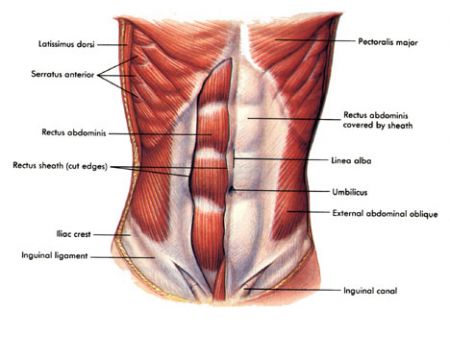
1) Rectus Abdominus - Front of torso
Flexion of spine, lateral flexion of the spine e.g. crunches, side bends
2) Erector Spinae - Back of spine
Extension of spine, lateral flexion of the spine e.g. back extensions, side bends
3) Internal Obliques - Side of torso
Rotation of spine, lateral flexion of the spine e.g. twisting crunches, cable wood chops
4) External Obliques - Side of torso
Rotation of spine, lateral flexion of the spine e.g. twisting crunches, Russian twists
5) Transverse Abdominus - Around internal organs
Compression of abdomen, drawing in of navel e.g. planks
Because of the different functions of the core musculature, it is necessary to train the midsection with a multitude of exercise to ensure balanced development which will ensure both good aesthetics and function. In other words as well as looking good (aesthetics) they will work well (function). Many abdominal routines are “all show, but no go” where as we ideally want to develop both show and go simultaneously!
The functions of the core can be divided into six specific movement patterns (hence the title of this article!) which need to be included when designing a core conditioning routine. Now, don’t worry if the list of movements seems dauntingly long or complicated, later in the article I will show you how to integrate these exercises into your current routine…
1) Flexion of spine – lifting shoulders
Crunches, sit ups
2) Flexion of spine – lifting hips
Reverse crunches, hanging leg raises, dead bugs
3) Extension of spine
Dorsal raises, back extension machine, deadlifts
4) Rotation of spine
Russian twists, cable wood chops
5) Lateral (side) flexion of spine
Side bends, side planks
6) Bracing/compression of abdominals
Planks, kneeling on a Swiss ball
As with all fitness training, whether it is bodybuilding, cardiovascular endurance, strength or flexibility orientated, there is no single “golden” routine which guarantees never ending results. To stimulate the improvements we seek from our bodies, we need to constantly challenge ourselves to work to higher levels of performance and intensity. The human body adapts very quickly to any stress that it is exposed to and, as a result, needs to be exposed to progressive overload in order to be stimulated to change positively. This means that, as our core conditioning improves, we must endeavor to increase the intensity of the exercises we choose to perform.
When considering the merits of a particular core exercise, it is vitally important to determine if we can make the movement more demanding as we improve the condition of the target musculature. If the answer is a resounding “no” then there are better exercises for us to choose! A good example of a poor core exercise is the old gym favorite the ab cradle.
With a little bit of practice, it is possible to perform literally hundreds of reps using this device which uses a lot of our valuable training but delivers very little in the way of progressive overload and therefore improvements in core conditioning. The ab cradle is an acceptable exercise for a complete beginner, but after a few short weeks, our newbie will have out grown this exercise and will need to do something more challenging to develop their fitness level further.
There are a number of changes we can utilize when progressing an exercise and by manipulating these “training variables” we can ensure we keep improving the condition of our target…
1) Increase external load (e.g. use a medicine ball, cable or dumbbell) to increase strength demand
2) Reduce rest time between sets e.g. from 60 seconds to 45 seconds to challenge recovery mechanisms
3) Increase volume of exercise (more sets or more reps) to increase muscular endurance demand
4)Increase complexity/technical difficulty of exercise e.g. progressing from a floor exercise to a standing exercise. Ground reactive core exercises tend to be more challenging and effective than those performed laying on the floor
5) Move more slowly (reduce tempo) to increase time under tension (TUT)
6) Increase the speed to develop greater muscular force/power
7) Progress from a stable to an unstable training surface (e.g. use a Swiss ball or Bosu) to challenge nervous system
8) Group exercises into “super sets” or circuits e.g. alternate between Swiss ball crunches and back extensions
9) Introduce static holds at point of peak contraction to extend duration of the set
10) Perform multiple exercises per function of the core musculature e.g. side plank followed by side bends
As a general rule of thumb, if it is possible to perform more then 20 reps of any given exercise in perfect form, it is time to use one of the training variables to bring the rep count down. Don’t waste time doing hundreds of reps of any core exercise … treat your abs like any other muscle group and keep the rep count in between 6 to 20 for maximum results in minimal time!
There are a number of options we can use for introducing our new “smart core” work into our weekly training programme. As we mentioned earlier, there is no “golden routine” which guarantees results. It’s a matter of deciding which option works best for you.
Option 1
Perform all core movements in a single session 2-3 times per week, completing 1-2 sets of 6-20 reps, one exercise per movement pattern.
Option 2
Divide the six movements into two groups of three, and perform one list on one day of your training week e.g. Monday, and the other list later the same week e.g. Thursday. Complete 1-2 exercises per movement pattern, 2-3 sets per exercise of 6-20 reps
Option 3
Divide the six movements into three groups of two and perform one pair on Monday, one pair on Wednesday and one pair on Friday. Perform 1-3 exercises per movement pattern, 2-4 sets per exercise of 6-20 reps
Option 4
Perform one movement per day, six days a week. Perform 2-4 exercises per movement pattern, 3-5 sets per exercise, 6-20 reps per set.
So, there we go – you now have all the information you need to create your own “six of the best” core conditioning programme which will speed you on your way to developing that fitness Holy of Holies … the six pack. Good luck and train both hard and smart.
Subscribe to:
Posts (Atom)


 Posts
Posts


